


‘From 4-star to 5-star: Heera Mandi and the Suburbanization of Baba Syed Safdar Ali Bukhari’
Bio: Kaki Mishaal is a senior History major at LUMS whose work explores the intersection of spirituality, gender, memory, and urban studies, driven by a deep interest in the life and legacy of Baba Syed Safdar Ali Bukhari (RA).
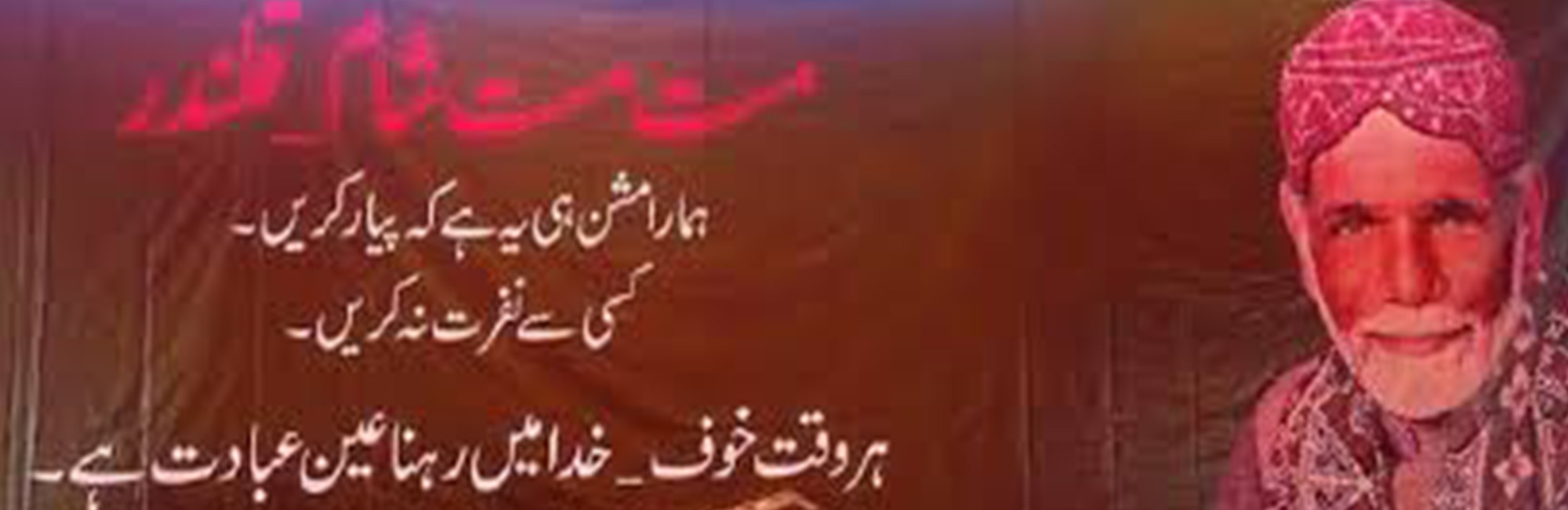
It was an early evening, and I was interviewing a few devotees of Baba Ji within the Mast Mast Healers’1 Community when suddenly, my eyes caught the image of an elderly man with deep and moist eyes, a gentle grin on his face, and a neat white moustache and beard. He was framed against a deep blue background, wearing a grey waistcoat over a blue shalwar kameez with an ajrak chaadar draped over his shirt and a matching ajrak cap in red and white adorned with small round mirrors. “This is Baba Ji”, one of the kakis2 told me, as I closely eyed the picture framed on the wall in the centre of the room. I looked at Baba Ji, imagining his struggles in Heera Mandi, as narrated by his followers. As I listened, my gaze shifted to a different space around me - an elite, suburban area symbolising modernity. The bold spatial contrast between the marginalized red-light district of Heera Mandi and this upscale residential neighbourhood piqued my curiosity, but even more fascinating for me was the transformation in the character of Baba Ji from a mere spiritual guide of the down-trodden kakis of Heera Mandi to ‘Dr. Baba’ (a term denoting the confluence of spirituality and science) housed in a posh and modern locality, catering to individuals from diverse social classes and backgrounds.
As I remained absorbed in the weight of these historical changes and continuities, I heard the kakis3 and kakas excitedly chanting, “Dr. Baba aa gaye hain” (Dr. Baba has arrived), before they simultaneously stood up for him in reverence and devotion. Dr. Muhammad Javed Ahmed 4, also known as Dr. Baba, is often seen carrying a stethoscope around his neck and a thin, brown stick in his hand. He sat at the room's western end, where countless kakis swarmed his chair, dressed in colourful outfits with elaborate makeup, perhaps contrasting the space's sacred ambience through their unseen, underlying devotion. Witnessing this scene left me in awe and wonder at the distinct ways in which gender, rituals, and devotion were enmeshed with each other, despite the change in spatial contexts from Heera Mandi to suburban Lahore.
Baba Syed Safdar Ali Bukhari, commonly referred to as ‘Baba Ji’ by his followers, was a Malamati5 Sufi saint who belonged to the Chishti, Qalandariyyah, and Suhrawardy Sufi orders6. Baba Ji hailed from the Bukhari Syed family of village Dhudi Thal in District Jhelum, Tehsil Pind Dadan Khan (a rural town northwest of Lahore)7. In the late 1980s, one of the significant turning points in Baba Ji’s life came as a result of the passing away of his mother, with whom he shared an intense bond, considering him his murshid, or spiritual mentor8. As a result of that event, Baba Ji was unable to contain his spiritual states of ecstasy (‘jazb-o-masti’) and, during his dastar-bandi9 ceremony, he released himself from the normative societal and familial expectations and ran away10. He stayed for seven days at Bari Imam in Islamabad, and later, upon “receiving an order to go to Lahore,”11 he settled for three days at Data Darbar.
On the third day, while he was standing at ‘Phajje kay Paye’, Baba Ji lost consciousness and once he opened his eyes, he found himself in the lap of a ghungroo-wearing girl (kaki) inside a kotha (brothel) in Heera Mandi, with the kaki offering Baba Ji her food, saying “Baba, eat
As a result of these events, Baba Ji ended up in Heera Mandi, setting up his astana12 in the house (kotha) of Kaki Firdaus* (the first kaki to meet Baba Ji in Heera Mandi and who was later married through him into a noble family), which marked the origin of his spiritual healing techniques through dhamal and music therapy in Heera Mandi, not only among the sex workers but also their families and other visitors who frequented the kotha spaces13. Baba Ji justified these modes of treatment on the basis that “disease is not just bodily, but it is mental as well,14” so in mankind’s quest for worldly gains, peace is lost and owing to the “absence of coherence between the body and soul,15” disease manifests.
For this purpose, while directing the heavily adorned kakis to sing and recite arifana kalam (mystical poetry), Baba Ji would tell the people gathered within the kotha: “Hear your heartbeat and listen to it through the ears of your heart; and be it known that you stand in front of Allah16.” Accompanying their loud, melodious voices, the musical beats of the tabla and harmonium would also complement the musical atmosphere.
However, the dhamal therapy was used for visitors who preferred dance over music. Sitting amid visitors at the kotha, Baba Ji would often, through a hand gesture, verbally instruct his kaki to start the dhamal on his own choice of kalam music. This would be accompanied by the classical music beats played by a few tabla and harmonium players who would be seated to the side near the stage. The kaki would then, unquestioningly, tighten her ghungroo, tie her dupatta in a knot to one side, and begin the dhamal. With a massive cluster of seated male onlookers gazing at her, the kaki would sing the kalam in her own voice and simultaneously dance vigorously in traditional attire, reverberating with bright and colourful accents.
The kaki would dance as if in a trance-like state, profusely sweating throughout her body and embodying intense devotion through her rapid and free-flowing bodily movements. While some male spectators would carefully follow her foot movements, a few would get swayed by the loud rhythmic bells of the ghungroo and the unrestrained movements of the kaki. Baba Ji would often try to redirect their focus by explicitly instructing the visitors to look at the foot movements of the kaki instead of her body, reminding them, “Kaki maa hoti hai”17 (A Kaki is a mother). The atmosphere would become charged as the spiritual and musical aura accentuates, and the kaki’s clanking of ghungroo bells every time she pounds on the floor, would present the superficial picture of a sensual dance performance garbed in a spiritual trance-like state to the visitors.
From the late 1980s to the late 1990s, Baba Ji continued these spiritual healing practices in Heera Mandi, which soon generated controversy and attracted vehement criticism due to his unconventional methods. Several journalists dismissed his practices by referring to him using derogatory titles such as 'Peer Kaki Taar' (lit. a spiritual guide who closely eyes women), 'Peer of Kanjar Shareef' (lit. a spiritual guide of the noble sex worker community), and 'Kanjrion ka Peer' (lit. a spiritual guide of sex workers). At the same time, some religious scholars even issued fatwas, calling his practices un-Islamic. Prime national newspapers, magazines, and journals launched a strong critique against him18; on the other hand, foreign media outlets documented these unorthodox spiritual healing techniques and distributed them worldwide. However, despite this heightened criticism, Baba Ji remained undeterred and gladly accepted the title of ‘Peer Kaki Taar’ and instead started writing columns on geopolitical and social issues under the same title, gaining popularity during the 1990s and early 2000s.19
In an attempt to confront the attacks levelled against him, Baba Ji made it clear that neither was he claiming to do religious preaching in Heera Mandi, nor was his work in that area only directed towards a specific religious faction20. Instead, his spiritual healing practices, including the dhamal and music therapies, were all-encompassing as they were directed at “drawing advantage for the benefit of humanity,21” hence, declaring him a ‘Peer’ was incongruent with the nature and purpose of his work. This is also testified in one of his responses to a special report published in ‘Roznama Jang’ that came with the headline ‘The infamous Peer, Peer Kaki Taar, who made sex workers dance has now been declared a religious scholar’ 22as he specifically pointed out: “I am neither a religious scholar nor a Peer or faqir; I am just a ‘deewana mastana’.23” Additionally, he also highlighted the hypocrisy and duplicity intrinsic to the society that branded him as ‘Peer Kaki Taar’, pointing towards the inherent elitism and pronounced dichotomy between the rich and the poor, alluding to the contrast between the ‘four-star’ and ‘five-star Heera Mandi’24. Baba Ji stated: “Whereas, holding musical and dance functions in big hotels by people of high society is regarded as ‘cultural’, conversely, when Baba does so, in the red-light district, then he is regarded as ‘Peer Kaki Tar’.”25
In 2000, as Baba Syed Safdar Ali Bukhari shifted from Heera Mandi to other areas within and outside the city, the shift from ‘four-star to five-star Heera Mandi’ became more pronounced. In this vein, the underlying meaning behind the transition from ‘four-star to five-star Heera Mandi’ not only entails a visible shift in socio-spatial contexts but also implies a multi-faceted critique of elitism and hypocrisy recurrent within the society. Though Baba Ji had shifted from Heera Mandi to Bhatti Gate in 2000, his immersion into the experiences and lives of the kakis in Heera Mandi and his attempts to provide a way out for them, as substantiated by the fact that he arranged marriages of around 300 kakis of Heera Mandi, made him a significant figure in the lives of those kakis, their very own ‘Baba’. In this sense, the absence of Baba Ji from the space of Heera Mandi and his shifting to other suburban spaces created another loss for these kakis, whom the society had previously rejected.
After Baba Ji passed away in 2005, Dr. Javed (Dr. Baba) is now the main conduit of his legacy in Lahore. As the leader of the 'Mast Mast Healers' Community, Dr Baba has been conducting dua sessions in the Services Hospital since 2007, practicing and institutionalizing a distinct set of spiritual-healing techniques, ranging from the ‘Surah Rehman Therapy’, ‘Qasida Burda Therapy’, ‘music therapy’, as well as ‘dhamal therapy’, based upon the guidance he received from his murshid (spiritual mentor), Baba Syed Safdar Ali Bukhari. However, later on, due to some logistical reasons, the community has been holding the sessions in the IEP Town since 2023.
During Baba Ji’s remaining life after his exodus from Heera Mandi, what had once just been a mehfil (gathering) for ‘dua’, now adopted the name of a modern ‘live dua session’. The modest room inside the ‘Bukhari House’ (the astana of Baba Ji located in the Bhatti Gate) where Baba Ji held some of these mehfils had now been replaced by a ‘dua room’ – a well-furnished, ornate, and spacious room heavily relying on the use of modern technologies, such as LED screen, microphones, speakers, and laptops for live streaming of the sessions on social media platforms.
Additionally, unlike the conventional langar distributed in mainstream shrine spaces, which mainly consists of traditional items such as daal and roti (the one that was given at the Shrine of Baba Ji in Lilla) or even biryani at a couple of other Sufi shrines, in this suburban locale, with the shift in spaces, the ritual of langar itself undergoes a ‘suburbanization’ process, resulting in items such as chicken roast with mint chutney, butter chicken with roti, etc. Apart from that, langar is also distributed in the form of small parting-off gifts (i.e., primarily imported biscuits, Iranian candies, or eclairs) given by Dr. Baba to the participants as they take leave from the ‘dua session’ at different intervals of time.
Interestingly, along with the ‘suburbanization of the langar’, it is essential to note that the gender roles accompanying this ritual also experience a shift as the legacy of Baba Ji transforms to a posh suburban locality. Though the preparation and management of langar was handled exclusively by kakis in household kitchens during Baba Ji’s ‘dua mehfils’, now several years after his death, as the process of ‘suburbanization’ in IEP Town unfolded, this responsibility has been taken up by the kakas. Presently, langar is imported from outside and cooked in huge cauldrons (deghs), which are then escorted to the kitchen in the ‘dua room’ by a few kakas. However, throughout the years, langar has always been supervised by kakis, as a middle-aged kaki, named Kanwal Hamid, has continued to oversee the management of the langar under Dr. Baba’s direction since 2017. The continued use and practice of the pre-existing spiritual healing sessions and the modes of spiritual healing in these suburban spaces highlight the fusion of classic spiritual traditions with modern suburban settings.
With the transformation in physical spaces, spatial contexts, and audiences from 4-star to 5-star Heera Mandi, i.e. the urban to suburban, the rituals Baba Ji had initially introduced in Heera Mandi also underwent a drastic change. The kalam, which was performed live by a sex worker years earlier, was now to be played on a loudspeaker featuring the voices of famous singers. As the society modernised, a range of different musical genres were incorporated into the music therapy, including Bollywood songs that are otherwise known for being centred on worldly love, and though a few of them featured obscene content, they were now viewed through a spiritual lens in the Community. Dhamal, which had once encapsulated the free-flowing body movements of the kakis and seemed so embedded into their selves that every gesture born on the kothas seemed synchronised with their mind and body, had now lost its vigorous pulse to a modernised space where the emphasis was on restraining and controlling one’s kaifiyat (states of spiritual ecstasy). The free-flowing and rapid bodily movements of the kakis during the dhamal had now been toned down in intensity with the introduction of the calm, measured recitations of the Surah Rehman and Qasida Burda, played through YouTube links over large loudspeakers. The previously male-dominated group of spectators sitting on the kotha floors, closely eyeing the live musical and dance performances, had now been replaced by an increasingly educated, middle and upper-class mixed-gendered group of people sitting on plastic chairs and leather sofas in suburban living rooms (now called ‘dua room’) who were required to close their eyes while listening to the kalam, qasida, as well as Surah Rehman and reflect inwards.
This underlying contrast between modern, controlled, suburban structures and the dynamic, polycentric, and fluid character of the spiritual practices illustrates how urban planning reconciles traditional spiritual values. Despite its structured and private outlook, these residential spaces provide residents opportunities to engage with the transcendent force of spirituality, demonstrating that spiritual practices modify their forms as societies and spaces transform. Hence, the organisation of dua sessions in the IEP Town is a prime example of the redefinition of spirituality in modern times within suburban locales. The shift in Baba Syed Safdar Ali Bukhari’s legacy is evident from his historical situatedness in traditional, organic, communal settings to its current manifestation in private households, green spaces, and small localised settings, yet operating with a transnational outreach.
*Names of Participants have been anonymised to maintain their privacy and confidentiality.
- The name ‘Mast Mast Healers’ was proposed by Mr. Syed Shakir Uzair, also known as ‘Syed Baba’, a devout follower of Baba Syed Safdar Ali Bukhari (R.A) as a title of the website for the Surah Rehman Therapy during the life of Baba Ji. Being 'Mast Mast' refers to a state of tranquillity, joy, and amity that one experiences in the presence of a faqir (spiritual figure). It is commonly used by Baba Ji’s kakas and kakis to denote feelings of joy and happiness. This title of ‘mast mast’ later became a title for the mystic sessions and gatherings held by Baba Ji as he engaged in spiritual discourse on a variety of topics. Following Baba Ji’s demise in 2005, these 'mast mast' sessions are still carried forward by Dr. Muhammad Javed Ahmed in Lahore, Pakistan and by Syed Shakir Uzair in Islamabad, Pakistan.
- Within the ‘Mast Mast Healers’ Community, a kaki refers to a female disciple of Baba Syed Safdar Ali Bukhari.
- Within the ‘Mast Mast Healers’ Community, a kaka refers to a male disciple of Baba Syed Safdar Ali Bukhari.
- In 2000, Dr. Javed contracted the HIV virus through a needle-prick as he was trying to save the life of a woman who had been infected with AIDS, Hepatitis B and C. After a two-year continuous struggle of finding a cure for it through biomedicine, he states that soon he realized the futility of his scientific knowledge and then resorted to the use of religion and spirituality as a source of treatment (i.e. through consultation with religious scholars, spiritual guides, etc.). Later, on the advice of one of his female junior colleagues (also a medical practitioner), Dr. Memoona Iqbal, he met Baba Syed Safdar Ali Bukhari, who told him to do the Surah Rehman Therapy for seven days, which miraculously cured him. This turning point in his life motivated him to spread the message of Surah Rehman and incorporate it in his medical practice, so that other patients facing similar hardships could benefit from this Therapy.
- The word ‘Malamati’ stems from the word ‘malamat’ (‘blame) and “signifies one who is blame-worthy”. See John A. Subhan, Sufism, Its Saints and Shrines: An Introduction to the Study of Sufism with Special Reference to India (Hassell Street Press, 2021), 314.
Interview with Dr. Muhammad Tariq, by author, Lahore, December 21, 2024. - “The Birth (Qalandar Pak Baba Bukhari RA),” Al Rehman, accessed May 19, 2025, https://alrehman.com/english/.
- Interview with Dr. Muhammad Javed Ahmed, by author, Lahore, March 22, 2025.
- “Traditionally, it is a custom followed wherein, a person in the family is chosen to bestow the honour of succesion after some elder has passed away and a ceremony is held to formalize the decision in which a turban (a long piece of cloth) is placed over the head of that chosen person.” See Syed Shakir Uzair, “Qurb-e-Haq (The Ultimate Dimension of Life),” Al Rehman, accessed May 6, 2025, https://www.alrehman.com/qurb-e-haq/, 10.
- “The Birth (Qalandar Pak Baba Bukhari RA),” Al Rehman, accessed May 19, 2025, https://alrehman.com/english/.
- Interview with Dr. Muhammad Javed Ahmed, by author, Lahore, March 22, 2025.
- John T. (John Thompson) Platts, “A Dictionary of Urdu, Classical Hindi, and English,” The Digital South Asia Library, January 1, 1884, https://dsal.uchicago.edu/cgibin/app/platts_query.py?qs=%D8%A2%D8%B3%D8%AA%D8%A7%D9%86%D9%87&searchhws=yes&matchtype=exact.
- Interview with Dr. Muhammad Javed Ahmed, by author, Lahore, October 19, 2024.
- Syed Shakir Uzair, “Qurb-e-Haq (The Ultimate Dimension of Life),” Al Rehman, accessed May 6, 2025, https://www.alrehman.com/qurb-e-haq/, 17.
- Ibid.
- Ibid, 18.
- Interview with Dr. Muhammad Javed Ahmed, by author, Lahore, March 22, 2025.
- According to a special report published by ‘Roznama Jang’ on Baba Ji’s practices in Heera Mandi, this prompted the ulema to level accusations of indulging in a major sin (gunnah-i-kabeera) and spreading immorality among the youth, which led the Kasur police to arrest Baba Ji along with eight of his kakis belonging to Heera Mandi on the pretext of his organizing musical and dance performances in Heera Mandi, Lahore. In addition, Baba Ji’s involvement with the kakis of Heera Mandi was also viewed with intense suspicion by the mainstream society, as indicated in the report published by ‘Roznama Jang’ that mentioned this as the sub-headline: “Two or three beautiful butterflies (kakis) are always seen accompanying Peer Kaki Taar.”
- Interview with Dr. Muhammad Javed Ahmed, by author, Lahore, October 19, 2024.
- “Tawaifayn Nachanay Walay Peer Kaki Taar ko Alim-i-Deen Bana Daala” Roznama Jang, n.d., accessed May 11, 2025.
- Syed Shakir Uzair, Al Rehman, accessed May 19, 2025, https://www.alrehman.com/qurb-e-haq/, 15.
- “Tawaifayn Nachanay Walay Peer Kaki Taar ko Alim-i-Deen Bana Daala” Roznama Jang, n.d., accessed May 11, 2025.
- Ibid.
- Interview with Dr. Muhammad Javed Ahmed, by author, Lahore, March 22, 2025.
- Syed Shakir Uzair, “Qurb-e-Haq (The Ultimate Dimension of Life),” Al Rehman, accessed May 6, 2025, https://www.alrehman.com/qurb-e-haq/, 16.
- Interview with Firdaus Hussain, by author, Lahore, April 25, 2025; Interview with Dr. Muhammad Javed Ahmed, by author, Lahore, June 22, 2024.
