


Between Virtue and Visibility: Beauty Parlours as a Site of Subversion for Working-Class Women of Chungi Amer Sidhu

Author Bio: Minahyl Haider is a student of Anthropology and minoring in Gender and Sexuality studies. She holds a deep interest in conducting ethnographic studies that highlight the roles of intersections, such as class, gender, and ethnicity, in the lived experiences of individuals in South Asia.
Occupying space whether a classroom, park, or marketplace demands adherence to specific, often unspoken, requirements. These requirements are defined by intersecting identities of class, gender, and ethnicity, which simultaneously enable and restrict access to public realms. The working-class beauty parlours of Chungi Amer Sidhu exemplify this dynamic. Within local norms, women are typically relegated to the domestic sphere, while public spaces like markets, mosques, and parks are designated male domains. The presence of female parlour owners thus subverts these norms: they enter the marketplace not as consumers, but as entrepreneurs.
This raises a critical question: How do these women navigate a rigid social structure that segregates the domestic and public, carving out space for themselves? Through subtle negotiations, they identify loopholes in societal expectations, enabling their participation in the public economy while maintaining community acceptance.
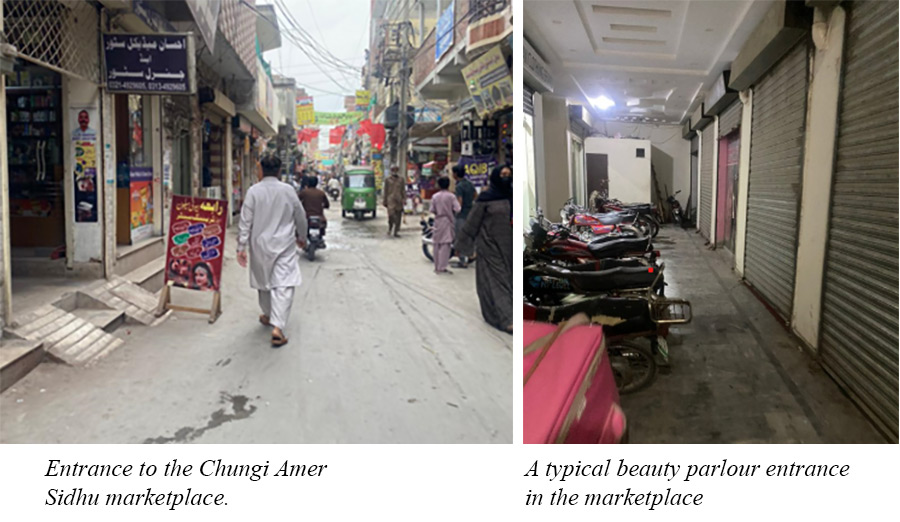
Securing physical space in the parlour demands strategic justification. Aisha, one of three owners interviewed, anchored her presence in financial necessity - supporting a daughter from her first marriage without burdening her second husband. Crucially, she framed her business acumen—managing rent, supplies, and operations as contingent on her husband’s "support." This narrative reassured the community that she was not independently challenging gender roles but operating under male oversight. Her rationale also tied the parlour to her domestic identity as a mother, vowing to close once her daughter married. Her husband’s weekly visits further legitimized her presence, signaling that her public role served familial duties not personal autonomy.
Unlike Aisha, Safa lacked immediate male backing; her husband worked in Karachi. Instead, she leveraged her children’s presence. Her parlour occupied a room in her home with a street-facing entrance, blurring lines between domestic and public space. She avoided constant visibility in the market: her sons loitered outside, alerting her when customers arrived. Their companionship during her brief commutes and their presence in the parlour (strewn with toys and children’s clothes) domesticated the space. This careful staging emphasized her primary role as a mother, rendering the business an extension of household management.
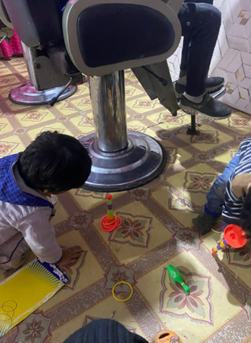
Children in Safa's parlour, reinforcing its domestic character.

Toys left in the parlour, enhancing its home-like atmosphere.

A child resting during parlour hours.
Fatimah, the third owner, also operated from a converted room in her home. Her justification echoed Aisha’s - covering household expenses for her aging father but she emphasized respectability. She distinguished her clients as "good women," avoiding "hur turhan ki aurtain" (all types of women), a term implying moral laxity. Fatimah insisted her parlour was strictly transactional, urging clients to leave after services. This contrasted with middle-class salons, where lingering is normalized. For Fatimah, respectability required rejecting any perception of the parlour as a leisure space.
Respectability emerged as a unifying theme. All three owners tied legitimacy to upholding domestic roles - the parlour must serve the household, not challenge it. Even Aisha, despite her husband’s endorsement, took steps to protect her reputation. During participant observation, when her parlour grew crowded, she closed its curtained door to muffle noise, a gesture reflecting anxiety about gossip and class-based judgments.
This study reveals the intricate negotiations working-class women undertake to inhabit public space. Their subversion is not overt rebellion but a calibrated performance of virtue. Agency exists, yet it is circumscribed by the imperative to prioritize domestic identity and secure patriarchal approval. The parlour succeeds only when framed as an instrument of familial duty—making respectability the currency of visibility