


Slashing the Painting: Gendered Resistance in River Spirit
By Ammar Ahmed & Saher Nadeem
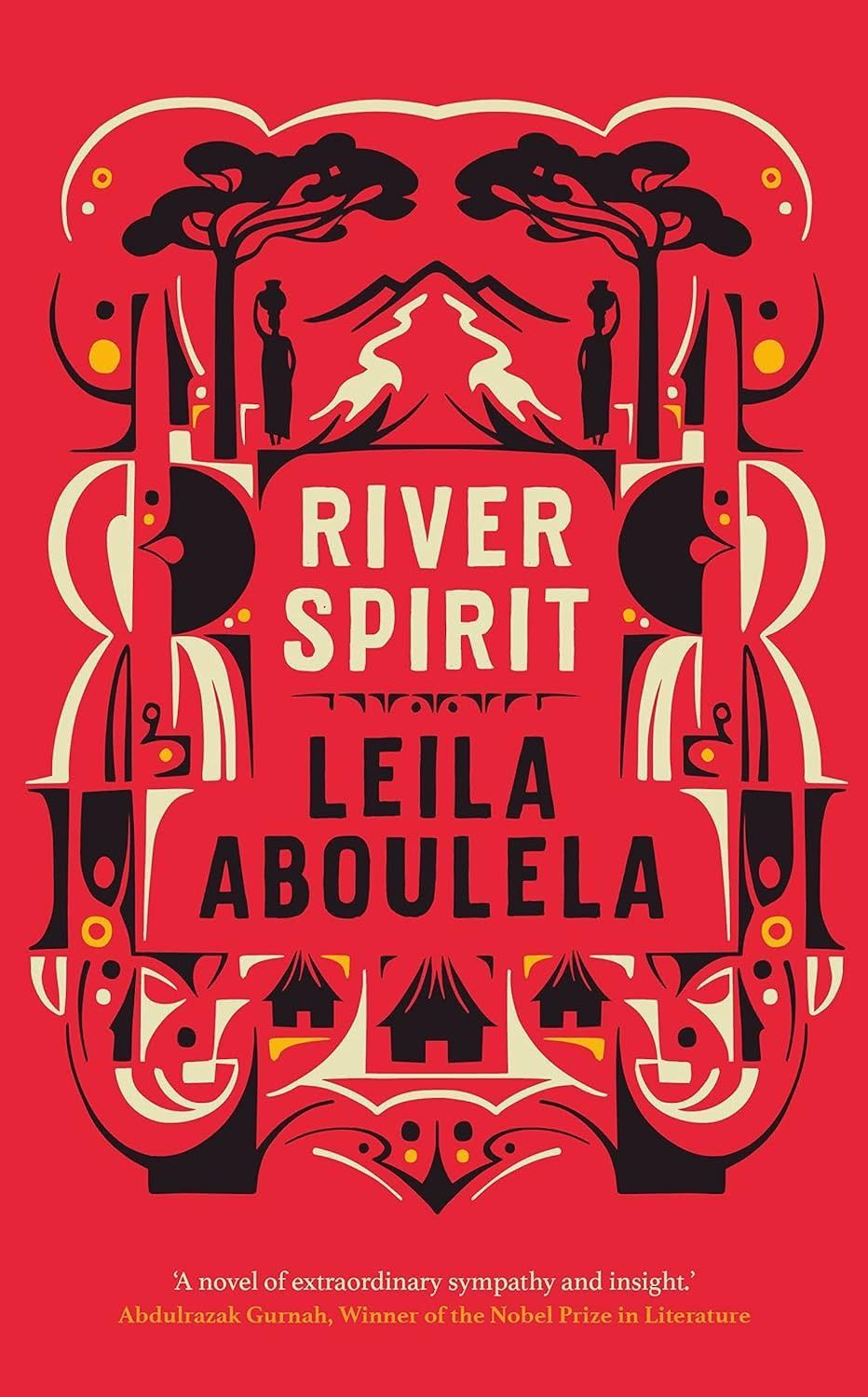
River Spirit by Leila Aboulela presents a story of 19th century Sudan struggling for independence under the false mahdi. When the protagonist Zamzam’s father is killed by raiders and their village destroyed, a young merchant Yaseen brings her to Al-Ubayyid, where she gets sold into slavery and traded from house to house. Zamzam is later bought by a white painter Rober who had settled in Sudan to pursue his artistic endeavors.
We argue that the colonial painter Robert’s action of non-consensually painting the protagonist reduces her to a mere object of containment. Next, we explore Zamzam’s blatant rejection of the painting through spitting on and slashing it as reflective of her agency in the face of this colonial extraction.
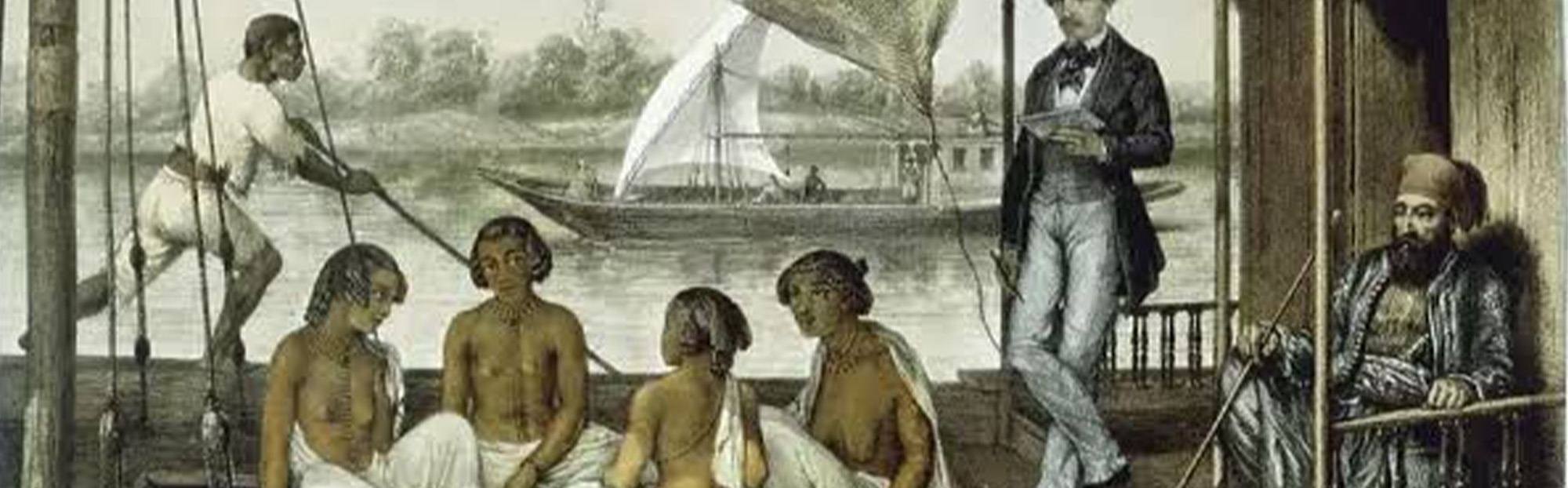
In River Spirit, Aboulela conveys that colonial power structures reduce colonized women to objects of observation and extraction. In chapter 8, Robert attempts to make a painting of a woman while focusing on the folds of the robe; he expects her to pose. The woman instantly interrupts his attempt and moves away while waving her hands as a gesture of rejection. Soon enough Robert is made aware of the cultural norms of privacy concerning women in Sudan, however his ignorance towards the norms makes him an exploitative colonizer. In a talk arranged by our supervisor, Aboulela mentions how the colonial paintings of women were never of common middle-class women, as the religion and the culture never permitted it, however they were advertised as such.
A perception of Sudanese women was manufactured that exoticised their bodies making the paintings purchasable for the London buyers. In one of her essays, Isra Ali talks about how misrepresentations of gender in the visual culture of North America and Western Europe about Muslim societies were created by the archetypal narratives of the colonial times. She states: ‘role of fine arts in forming perceptions of Muslims and Islam in European societies at the height of colonialism reveals the origins of the emphasis of gender in visual representation “of the Muslim World.”’1
These forms of cultural production are not meaningless; the repercussions are politically strong and difficult to reverse. The colonial project finds its way to justify its actions. In such circumstances, the act of resistance becomes necessary. Zamzam’s position as a subject of colonial times and the object of Robert’s painting is a condition where must reject subjugation.
In chapter 12, Robert’s character is drawing a picture of the protagonist who in that moment of the narrative is under his enslavement. Zamzam feels profoundly irritated and uncomfortable. The author writes: ‘It made Zamzam anxious, as if he were scraping bits of herself.2’ Aboulela’s description of this is a visceral metaphor which suggests that the artistic gaze of the white man is a violent extraction of her spiritual ontology. Where the physical body is observed, her personal essence is violated. The author uses this textual instance to critique how colonial power reduces the colonized women to passive objects of consumption stripping them of autonomy and denying them of any humanity.
However, later in the novel, Aboulela presents Zamzam as an agentful protagonist when she rejects Robert’s portrait. In chapter 13, Robert’s character completes the drawing and shows it to the protagonist. The author writes concerning Zamzam’s reaction: ‘she spat on the canvas.3 This action defiles the painter and colonial power structures at large which attempt to restrict female subjects to mere objects. For Robert, Zamzam is an aesthetic pursuit; he wishes to capture ‘The way color reflected on her skin. The raised tribal scars on her stomach, muscular, almost boyish arms. Nose ring.4 Zamzam is made into a subject of sight, exoticised for the viewership of London buyers. Thus, Zamzam’s rejection represents the reclamation of her image from the white man’s gaze. Ultimately, Zamzam’s act transforms her from a passive subject of art into an active participant in her own liberation.
This active participation reaches its apex in chapter 17 when the protagonist ‘took a knife from the kitchen and slashed the painting.5 The protagonist acts rebelliously conveying her overt rejection of Robert’s attempt at ‘paralyzing her on canvas.6 The protagonist’s use of the knife makes it more than just a domestic utensil. It becomes a tool of liberation. By ruining the art, the protagonist engages in an assertion that her identity is far more complex than any colonial representation could ever capture or depict.
This textual example further illustrates that for the colonized subjects; the assertion of a sovereign identity is only possible through the deliberate and forceful dismantling of external narratives. Not spitting on the canvas but tearing the painting is required by the protagonist to reclaim her identity from the colonial gaze.
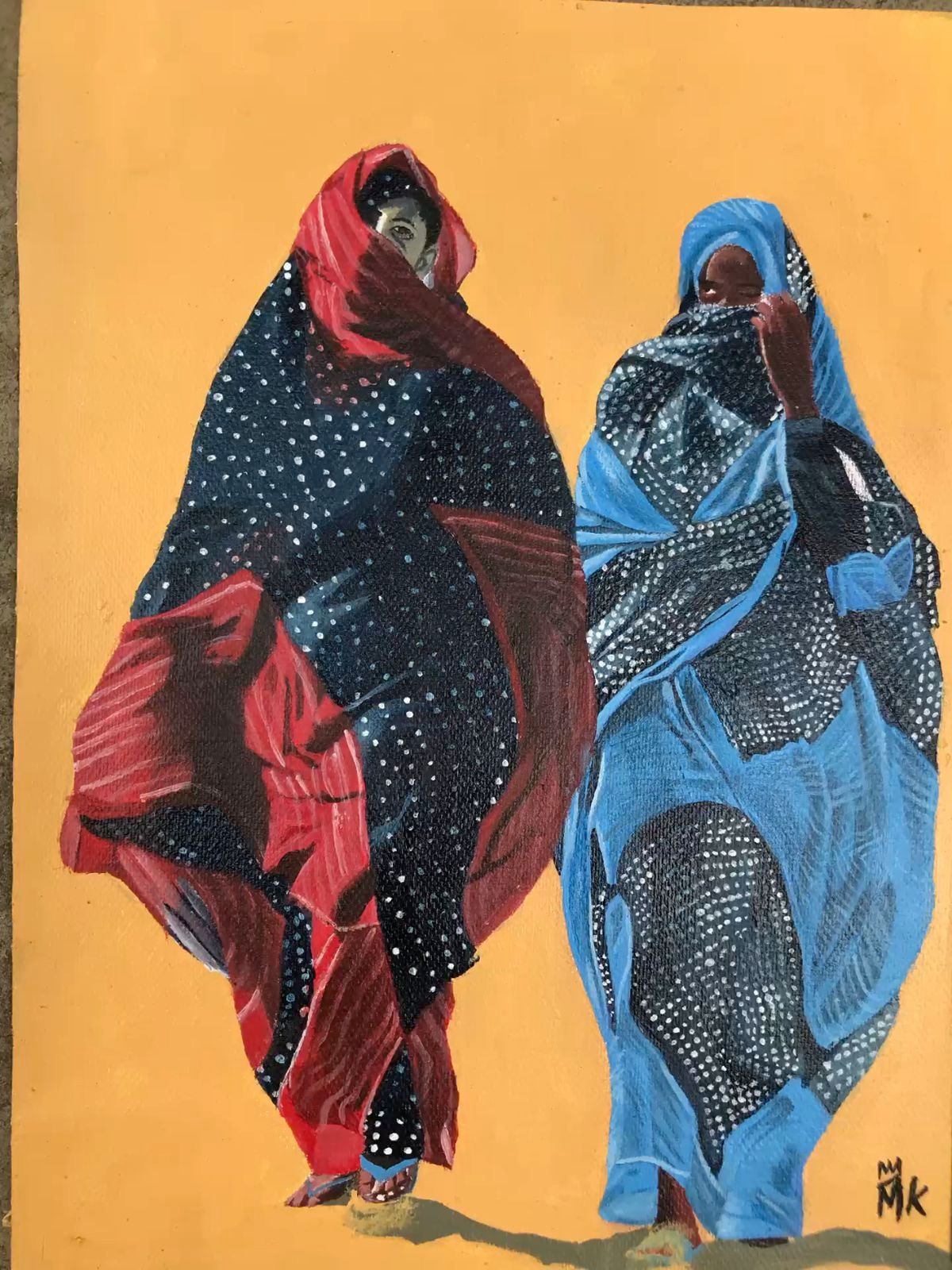
Where colonial paintings like Robert’s depict Muslim women as passive sexual objects, paintings from within the Muslim tradition portray women as active and agentful individual beings. In one of her books, Moroccan feminist scholar Fatema Mernissi writes: ‘Often, they [Muslim women] were depicted [in paintings] as aggressively involved in changing the world and constantly on the move — riding horses like Princess Shirin in “Khusraw and Shirin,” or camels, like Zuleikha in the biblical story of Joseph.7 Women here were always in motion, not stationary or sexualised as seen in colonial paintings. Considering Mernissi’s proposition, had Zamzam been painted by an artist from within her culture, demands of consent and representation would have been at the centre of the artistic practice.
This comparison of colonial paintings with those by Muslim painters lends itself as an important counter-narrative. As Muslim depictions were more nuanced and for the subject more liberatory, these paintings stress that to adequately acquaint oneself with Muslim realities, one needs to engage with Muslim narratives and art works. In the context of River Spirit, this means that Robert’s painting can offer nothing but a distorted depiction of Zamzam. Overall, instead of blinkered colonial paintings, engagement with indigenous cultural narratives and artistic productions is necessary to evade false perceptions of cultures different from yours.
To conclude, the protagonist’s rejection of the portrait, Leila Aboulela argues for the agency of the female subject in the face of the colonial project that entails containment and breeds misrepresentation. Furthermore, Muslim narratives and art pieces help provide an alternate insight to their cultural nuances as compared with the shallow and biased depictions of colonial paintings.
Ammar and Saher are third-year literature students at the LUMS - School of Humanities. Ammar enjoys baking cakes and is an avid listener of Hindustani classical music. Saher is often found either dancing or attempting to complete her assigned readings for the week.
- Isra Ali, “The Harem Fantasy in Nineteenth-century Orientalist Paintings” (Dialectical Anthropology, Vol 39, 2015) p 1.
- Leila Aboulela, River Spirit (London: Saqi Books, 2023), chap 12 p 153.
- Aboulela, River Spirit, chap 13 p 160.
- Aboulela, River Spirit, chap 13 p 160.
- Aboulela, River Spirit, chap 17 p 199.
- Aboulela, River Spirit, chap 17 p 195.
- Fatima Mernissi, Scheherazade Goes West: Different Cultures, Different Harems (New York: Washington Square Press, 2001), chap 11 p 123.