


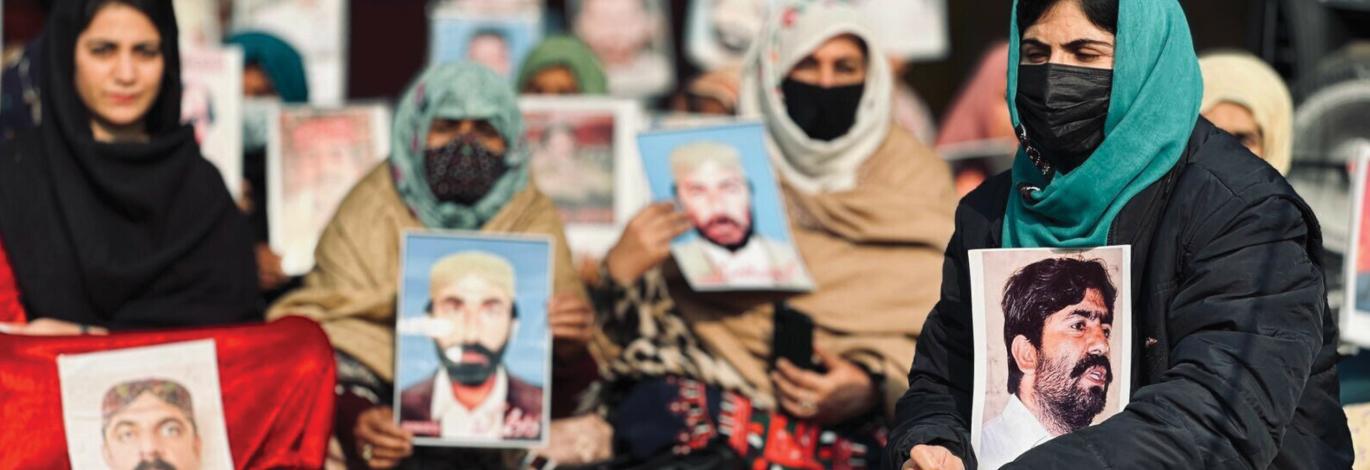
So much of women’s work, whether that is carework or paid work, particularly in the informal sector, is unseen and yet indispensable. Unfolding in homes, and behind veils, Baloch women’s work is unique in that it interlaced with grief - of enforced disappearances and militarization that affects their labor and their household alike. Indeed, women in Balochistan carry out their economic and domestic labor while also grieving for their loved ones. There are no clear boundaries between waiting and working: The hands that sew intricate embroidery do so whilst mourning their family members without a grave, and waiting with uncertainty. This exemplifies a slow violence that is not abrupt, does not make it to news headlines.
This also reflects the gendered dimension of political violence, where these Baloch women disproportionately bear the economic and social costs. Understanding Baloch women’s lived experiences in which they navigate coping strategies, while also sustaining their communities and households, shows that they are not passive victims, and mirrors the gendered political economy of Pakistan.
Naseema joins the missing persons camp most days for her missing brother, who disappeared in 2014. For Naseema, it’s been 12 years since she has been mourning for her brother. Her brother’s wife has not been well since he disappeared. She is not ill exactly, but it is something that has no medical name. It is a slow collapse that manifests physically because the body orbits around the grief. Naseema’s mother also passed away, while mourning and waiting for her son. She told her mother that she had stopped eating well,to be hospitalized, and died of cardiac arrest. Naseema knows it was not merely a cardiac arrest, but the body’s limit of waiting. But, for Naseema, life insists on continuing. That’s how grief and hope coexist for Baloch women.
Understanding Baloch women’s lived experiences in which they navigate coping strategies, while also sustaining their communities and households, shows that they are not passive victims, and mirrors the gendered political economy of Pakistan.
Naseema loves playing with her nieces and nephews, but it also comes with responsibilities. She does the grocery shopping, goes to the market where roads are often unsafe, and when she gets home, she cooks. Despite the kitchen feeling like a place where time has become strange, her brother and mother are absent yet present everywhere emotionally, there are children to feed and elders to take care of.
Naseema’s daily life is structured around many responsibilities, which she manages largely on her own. These tasks also represent a continuous expenditure of physical labor and time, which remain essential to the functioning of the household. Such care work is an active investment in the well-being of her family despite grieving simultaneously for her brother.
In another home, Kulsoom sits by the window with her legs crossed, with a pile of fabrics in her lap. She knows the art of doing Balochi embroidery and the faster she finishes, the earlier she can finish her order and earn some money. For Kulsoom, the pay is low and sometimes delayed. Her fingers ache due to their steady movement through the cloth, but still she continues. Her brother has been gone for years, and this heartache governs her life. When she stitches, she thinks of her brother, while her mother recites a prayer in the room on the prayer-mat, hands cupped, praying for her son’s safety.
Kulsoom attends college— she is studying pre-medical. She chose the path to pursue medicine before her brother disappeared. Now, her desire to become a doctor seems like a scattered dream since her brother disappeared. She feels her home is a fractured household in financial crisis. When she comes back home from college, she studies, and on weekends she sews and earns, keeping her family’s head above water.
Sometimes, she goes to the local court hoping to find her brother. Indeed, Kulsoom moves forward with life by choosing what is best for her family while also demanding justice. She does all this while carrying the psychological weight of unresolved loss. But this does not replace or halt her domestic responsibilities and paid work.
These lived realities of Baloch women reflect the complexities of their lives. They grapple with violence, loss, and uncertainty while performing their everyday roles as caregivers. They are also thrusted into becoming breadwinners and sustaining their families through paid work.
The radical act for Baloch women is not always in dramatic revolutions, but in the simple act of continuity in their everyday, mundane lives. The refusal to stop. To keep filing for petitions in court, even when they are adjourned without result.
In Balochistan, structural invisibility is compounded across three layers that makes Baloch women’s lived experiences complex and intertwined. The first is the geographical marginalization. Since the inception of Pakistan, Balochistan has seen an extraction of its natural resources, without equivalent investments back into the province by the federal government – an ‘internal colonialism’2. Secondly, the militarization of the region not only creates threats but also creates gendered vulnerabilities, where women’s hypervisibility means that they have to navigate public spaces with calculated risk3. Thirdly, patriarchal dynamics operate across multiple scales—at household, community, and institutional levels. These shape the power relations, everyday experiences of women, and access to resources, invisibilizing much, if not all, of the work that they do. These women are at the stove, at sewing machines, in the kitchen, at protests, in missing persons camps, in the market, haggling without apology. They are doing all this while mourning and living in the uncertainty of perpetual violence.
The radical act for Baloch women is not always in dramatic revolutions, but in the simple act of continuity in their everyday, mundane lives. The refusal to stop. To keep filing for petitions in court, even when they are adjourned without result. To keep sewing, and to keep building even with accumulated grief and fear. To understand these women’s labor in all its dimensions in Pakistan, we must begin by expanding the definition of development and labor. Here, there is a need to go beyond paid work, that is often the easiest to define and measure, and encompass acts of care and domestic maintenance and responsibilities: tasks that often go unremunerated and invisibilized but remain at the core of what ultimately sustain us. Recognizing these women’s invisible labor exposes the forms of exploitation and violence that come into play. It also requires a nuanced understanding of women’s autonomy and economic value, which needs to be contextualized on the basis of gender, class, geography, citizenship, and ethnicity.
Kinza Fatima is pursuing her PhD in Political Science, with a Feminist Concentration in International Politics at the University of Cincinnati. Her areas of interest are gender and militarization, political economy.
- Author has used pseudonyms to protect the identities of interlocuters
- United Nations, Human Rights Council, Written statement submitted by the Center for Victims of Torture, a nongovernmental
organization in special consultative status, Fifty-ninth session, Agenda item 9, UN Doc. A/HRC/59/NGO/335
(April 15, 2026), https://docs.un.org/en/A/HRC/59/NGO/335. - Gqola, Pumla Dineo, et al. “Gender and public space.” Gender & Development 32.1-2 (2024): 1-25