


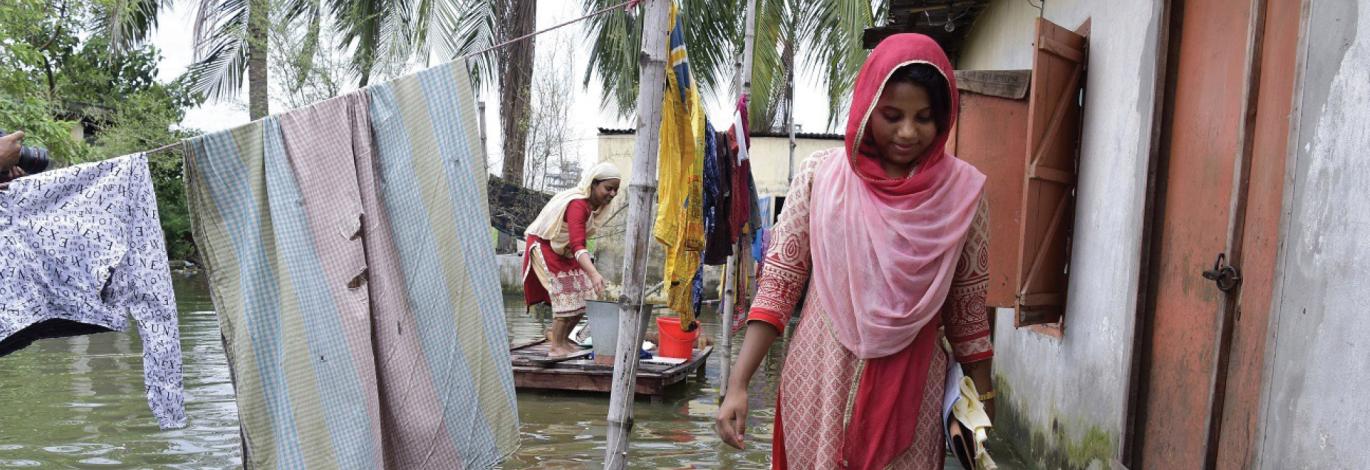
When disasters sweep through cities, they are often described as “gender-neutral”, yet they impact vulnerable populations, including women of lower socioeconomic status and pregnant women disproportionately1. Worldwide estimates indicate that around 80% of climate change affectees are women2; facing loss of livelihoods, gender-based violence (GBV), and challenges in accessing sexual and reproductive health (SRH) as well as family planning (FP) services when climate disasters strike. Here, social, economic and cultural factors, including gender roles, discrimination, and existing inequalities, such as restricted mobility or access to resources3, amplify women’s vulnerabilities.
While responses to disasters and the following mobilization efforts seem impartial, in reality these often mask biases. Indeed, most climate and disaster responses are designed around the survival of a “default” citizen who is mobile, male, economically active4, and unburdened by care work5. When floods hit, the evacuation orders assume people can move quickly, swim if needed, and leave home without permission. These assumptions are not neutral. Instead, they actively negate gender by treating male experiences as universal and rendering women’s realties as invisible.
For example, during the Gujarat Floods in India, disaster warnings reached men faster than women because they were given through television, radio and mobile phones which men typically have greater access to6. Furthermore, women found it difficult to evacuate to safer areas because they were not encouraged to learn how to swim7. Similar instances of deprivation have been recorded for Pakistan too. During the Pakistan floods of 2022, around 650,000 pregnant Pakistani women were estimated to lack access to healthcare and were forced to give birth under the open sky8. Almost eight million girls and women lacked access to toilets and basic menstrual hygiene products9. Additionally, an increase in sexual violence was also reported against women10. This is not an accidental oversight but rather a deliberate blind spot that reveals a deeper hidden bias: early-warning systems, evacuation plans, relief camps, food distribution, and health services systematically fail to consider the needs of women and girls.
The statistics above reveal that so long as disaster response strategies continue to ignore gendered realities, affected women will remain at risk. This holds true even when we consider broader climate-related, and not just disaster focused, responses.
The statistics above reveal that so long as disaster response strategies continue to ignore gendered realities, affected women will remain at risk. This holds true even when we consider broader climate-related, and not just disaster focused, responses. Around 158 million women will be pushed towards poverty by 2050 due to climate change11. Clearly, climate change exacerbates existing inequalities and pushes vulnerable groups deeper into the margins. Therefore, adopting gender-responsive disaster management and climate adaption frameworks is imperative to reducing inequalities and achieving sustainable development.
Similarly, there is an immediate need to bridge policy gaps so that women and girls can thrive in the face of climate-related challenges. There is a need for gender mainstreaming in all policy targets and goals as it is important to increase their effectiveness, fairness and sustainability. A few steps can be taken to support this approach.
Foremost amongst these is to design inclusive policies through active community engagement. Here, it is imperative to ensure the participation of women in designing and implementing culturally relevant and acceptable interventions regarding women’s protection and their health. Initiatives must take into account gendered pressures, expectations and norms. Engaging multiple stakeholders within the community (and beyond) while making women the primary partners in the design process will allow for better take-up and implementation of projects while creating potential for greater impact for change as well. For this to effectively happen though, we must focus on data for development.
It is vital to collect data to understand the situations and ground realities of women which will aid in policy making. Similarly, budgets for disaster management must be gender-responsive, with gendered analyses of fiscal responses to disasters made standard practice. Such data can help governments identify where women face the greatest vulnerabilities and service gaps, allowing resources to be allocated more equitably and efficiently. In turn, this can ensure that funding for healthcare, protection services, relief distribution, safe shelters, sanitation, and livelihood recovery directly reflects the differentiated needs and experiences of women and girls during and after climate disasters.
Engaging multiple stakeholders within the community (and beyond) while making women the primary partners in the design process will allow for better take-up and implementation of projects while creating potential for greater impact for change as well.
Finally, Pakistan must develop gender responsive Nationally Determined Contribution (NDC) plans. NDCs are action plans submitted by each country under the United Nations Framework Convention on Climate Change to show how they intend to reduce emissions and adapt to the impacts of climate change12. The NDC is customized to the country’s national circumstances, capabilities, and development priorities, and reflects the nation’s commitment to global climate targets. Here, building “a gender-responsive monitoring, reporting and verification system” into our NDCs will go a long way in helping improve gendered outcomes post disasters and as we build systems to combat the effects of climate change.
Hence, while it is important to include gender-inclusive policies and build data frameworks it is equally important to systematically assess how gender-responsive disaster management and climate-response interventions really are. After all, it is only through the implementation of gender-aware systems that we will truly support gender equality 13 in the face of increasingly frequent and severe climate disasters.
- Ajibade, McBean, and Bezner-Kerr, “Urban Flooding in Lagos,” 1714–1725.
- Waheed, “Climate Change’s Greatest Victims Are Women and Girls.”
- Papadiochou et al., “Impact of Climate Change on Reproductive Health and Pregnancy Outcomes.”
- Caroline Criado Perez, “Invisible Women: Exposing Data Bias in a World Designed for Men” (2019).
- UN Women, Explainer: Why Gender and Intersectionality Matter in Disaster Risk Reduction (2023).
- Ahmed and Fajber, “Engendering Adaptation to Climate Variability,” 33–50.
- Ibid.
- Waheed, “Climate Change’s Greatest Victims Are Women and Girls.”
- Ibid.
- Pradhan, Najmi & Fatmi, “District Health Systems Capacity in Pakistan.”
- UN Women, Gendered Impacts of Climate Change (2023).
- UNFCC, Gender and Climate Change (n.d.)
- UNDP, Gender and Climate Change in South Asia (2023)