


In contemporary Pakistan, the dars, an informal gathering, typically held in a private home, in which women come together to study and discuss Islamic texts, has become a central yet deeply contested site of social and moral negotiation. Alongside a largely domestic and independent practice, the drawing room dars has also increasingly intersected with the programmes and networks of formal religious organisations, including Al-Huda and the women’s wings of parties like Jamaat-e-Islami, particularly from the 1980s onward. Emerging in the context of post-Zia Islamisation, the Afghan Jihad, and the global war on terror these spaces have shaped new forms of Islamic education and practice among urban, middle-class women, offering an alternative vision of piety that departs from dominant narratives of Islam as either oppressive or extremist.”
In my research I explore how a female-led dars in Peshawar functions as a space where women use Islam itself to negotiate the constraints of a patriarchal order, generating new forms of community and authority. Through three months of participant observation and interviews, I use Mahmood1‘s concept of piety to understand these women’s agency as operating within patriarchal structures of power while also simultaneously cultivating space, community, and friendship through religion.
The dars I study is led by Dr. Nadia Ali, a senior member of Jumaat-e-Islami and the retired senior Professor in a university in Peshawar. It began when Haniya, the hostess, expressed her desire to host a dars. When I asked Haniya, whose husband is also a Jumaat-e-Islami member, why she had wanted to take the initiative, she said she wanted to “bring people together in the name of God” — but also simply to get to know the people in the neighbourhood. This gathering has since become the site of relationships that have deepened with time.
These women work around their families’ timetables to find time for the dars without causing disruption at home. They work within societal expectations of domesticity and do not leave the home to practise piety.
Ali uses everyday life as a site of comparison in her dars, encouraging her students to be not passive receivers but political actors. In one discussion of the Quranic word qiyam, she explained that to truly follow God’s word, one must be in a position of power to “establish” God’s laws, not merely pray five times a day, but engage actively with the political world. She actively fundraises for JI and Al-Khidmat and is critical of parties that adopt an “Islamic touch” for electoral appeal. She also believes in engaging with different groups of people across the spectrum of religious practice, believing that each person has something to contribute and to learn.
The members of this dars are largely housewives or retirees, which is why, when the timing shifted from 4–6pm to 11am– 1pm for the winters, it caused little inconvenience. It was, in fact, preferred, since husbands and children were away at work or school. However, this change meant that working women couldn’t attend and could only exist on the outskirts of this community.
These women work around their families’ timetables to find time for the dars without causing disruption at home. They work within societal expectations of domesticity and do not leave the home to practise piety. Instead, they remain within it, moving between homes in ways that are legible as domestic and therefore uncontroversial. This movement through domestic space is precisely what allows these gatherings to persist without provoking pushback.
When a national holiday clashed with the day of the dars, multiple women had texted in the dars group chat asking whether it would go on for that week. While the dars had gone on, despite Haniya’s husband being at home, it had caused significant anxiety. There had been multiple phone calls between the different members asking the same question and thinking for alternatives. That day, before it had begun, Khozaima had laughed and commented, “Of course, we women would still gather for the dars, one man’s presence couldn’t stop this”, even though the previous day’s anxiety was testament to the fact that it very easily could have.
Within this new community, these women deeply value the spaces they carve out for themselves, both as hosts and participants. Men’s spaces, by contrast, appear readily available: in housing society parks, mosques, outside them, corner grocery markets, streets, and drawing rooms or hujras, often occupying entire basements in newly built houses in Peshawar’s DHA2. Women on the other hand, as is obvious in the participants’ anxiety and in Khozaima’s remark, must meticulously carve space out and, aware of its fragility and value, actively work to sustain and protect it.
Mohsina, a newly retired single mother, told me that during the nine years she spent in her previous colony she barely knew anyone. Everyone, she said, was “locked up” in their homes. Her afternoons had become especially lonely after her children moved out, but now she looks forward to the dars and the community she has found there. The dars becomes an avenue to find community and friendship that might otherwise have been considered unnecessary, frivolous or otherwise inaccessible considering the lack of alternative community gathering spaces for women of the neighbourhood.
Two months into my fieldwork, Haniya’s mother suddenly fell ill and passed away within the week. The dars took place that week at her nextdoor neighbour Khozaima’s house. While the women discussed when they should go to Haniya’s for dua, Khozaima said: “We must go soon, we have khorwali” (sisterhood). The khorwali extended far beyond a condolence visit. The women collectively sent food to Haniya’s home for days and Khozaima hosted the dars for the following weeks. Members have since started checking in on those who don’t attend, or who are known to be struggling with their mental health.
Alongside grieving together, these women also celebrate together. When Fatima’s daughter Aimen was getting married, all the women pitched in to throw her a mehendi party. Mohsina’s daughter is also getting married, and she has sent invitations to all the women of the dars. These women met through a religious gathering, and within months cultivated relationships that extend well beyond its original context.
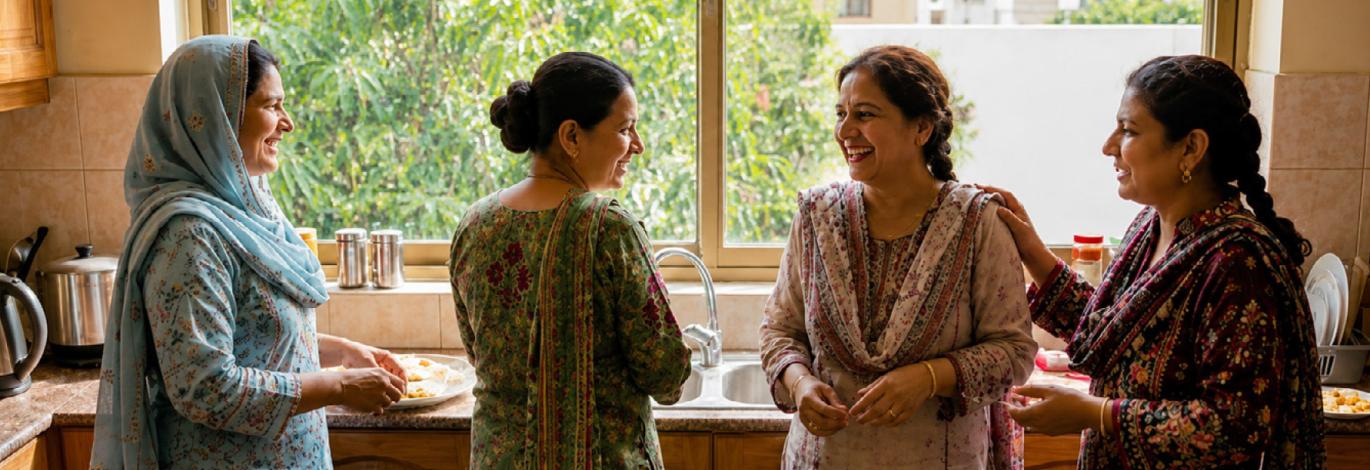
Women in Peshawar not only brought snacks to contribute to the chai after dars but also helped with cleaning up.
Therefore, I believe that this dars exists as a space that goes beyond simply participating in the global piety movement. It is also a means for women to use religion to carve out space for themselves, to meet people, form friendships, and socialise. These friendships are nurtured week by week, gradually becoming warmer and more sincere. Women in Peshawar not only brought snacks to contribute to the chai after dars but also helped with cleaning up. The dars would often not end in the drawing room, but in the kitchen, with everyone coming together to wash dishes and wipe down kitchen counters. These moments of intimacy centre my essay, where these women not only find kin in these gatherings, but sustain those relationships, not for society or their husband’s social circles, but for themselves, for khorwali.
Tooba Adina Naeem is a Senior at LUMS with a major in Anthropology and a minor in History.
All names used in this paper have been changed to pseudonyms to protect the anonymity of participants, in accordance with the preferences of the dars members, except Mohsina’s who wished to have her real name used.
- Saba Mahmood “Politics of Piety”
- Defense Housing Authority, Peshawar is a new upper middle-class neighborhood in the city. The housing colony is majorly empty or under construction.