



Introduction
Pakistani weddings have long been important social and cultural events shaped by ritual, kinship, and collective celebration. Today, however, social media increasingly influences how weddings are imagined, planned, and experienced. Instagram reels, bridal photoshoots, cinematic trailers, and influencer aesthetics have transformed weddings into highly visible performances consumed both online and offline.
Drawing on interviews with brides, parents, photographers, makeup artists, and designers, alongside participant observation, this study examines how weddings have become sites of performativity, class signalling, and psychological pressure. Erving Goffman’s dramaturgical framework helps explain this transformation, as weddings increasingly function as performances directed simultaneously toward physical guests and digital audiences. While social media presents weddings as glamorous and aspirational, our findings reveal the labour, comparison, and anxiety behind these curated images.
Pre-Wedding Formation: Social Expectations and Pressure
For many participants, wedding pressure began long before any formal planning took place. Brides described growing up surrounded by conversations about beauty, marriage, and family reputation, and by the time they became engaged many already carried internalized ideas about what their wedding should look like. One bride remarked, “I had Pinterest boards before I even knew who I would marry.” Another described how relatives began discussing venues, outfits, and guest numbers the moment her engagement was announced: “It felt like the wedding belonged to everyone before it belonged to me.”
Parents frequently viewed weddings as reflections of family honour and social standing. One mother admitted that even when families wanted smaller ceremonies, they feared being judged for appearing “less capable” than others in their social circle. This pressure was not simply financial but symbolic. It was also heavily gendered: brides consistently carried the greatest burden, describing constant comments about weight, skincare, appearance, and posture. One recalled being told to begin skincare treatments months before her engagement was even announced. “Everyone keeps reminding you that all eyes will be on you,” she explained.
Social media intensified these expectations. Brides repeatedly described comparing themselves to highly curated wedding content and often feeling inadequate before planning had begun. One explained that scrolling through Instagram made her feel every wedding needed to be “unique, aesthetic, and expensive,” while another admitted her own plans suddenly felt “too simple.” This pressure was deeply tied to class. Lower-income brides were particularly conscious of the standards being normalized online; one avoided posting photographs because she felt her wedding “didn’t look Instagram-worthy.” Wedding culture therefore increasingly reproduces class distinctions through digital visibility.
Designing the Wedding: Commodification and Digital Influence
As planning begins, social expectations become material decisions. Weddings now involve extensive networks of photographers, makeup artists, stylists, decorators, and social media teams, a commercial wedding industry centred on aesthetics and branding, where family networks once organized everything.
Designing the Wedding: Commodification and Digital Influence
As planning begins, social expectations become material decisions. Weddings now involve extensive networks of photographers, makeup artists, stylists, decorators, and social media teams—a commercial wedding industry centred on aesthetics and branding, where family networks once organized everything.
Designers and makeup artists noted that clients often arrive with Instagram screenshots rather than original ideas, referencing celebrity weddings, influencer campaigns, and viral bridal looks. “People don’t ask what suits them anymore,” one designer observed. “They ask for what they saw online.” Social media therefore functions both as inspiration and marketplace, with a single viral bridal look capable of shaping client demand for an entire season. During fieldwork, several weddings included neon hashtag signs, staged selfie corners, and backdrops designed specifically for online engagement.
Designing the Wedding: Commodification and Digital Influence
As planning begins, social expectations become material decisions. Weddings now involve extensive networks of photographers, makeup artists, stylists, decorators, and social media teams—a commercial wedding industry centred on aesthetics and branding, where family networks once organized everything.
Designers and makeup artists noted that clients often arrive with Instagram screenshots rather than original ideas, referencing celebrity weddings, influencer campaigns, and viral bridal looks. “People don’t ask what suits them anymore,” one designer observed. “They ask for what they saw online.” Social media therefore functions both as inspiration and marketplace, with a single viral bridal look capable of shaping client demand for an entire season. During fieldwork, several weddings included neon hashtag signs, staged selfie corners, and backdrops designed specifically for online engagement.
Traditions have not disappeared; they have been repackaged through digital and commercial logics. Rituals such as mehndi and rukhsati remain central, but their presentation increasingly prioritizes visual appeal and shareability. Photographers described families restructuring timelines and lighting around photography requirements; at one wedding, the bride’s entrance was delayed because videographers wanted better lighting for cinematic footage. Global and diasporic influences shape these developments further, as participants frequently referenced weddings seen abroad or through Pakistani influencers overseas. The result, one designer noted, is “global aesthetics with local rituals” celebrations that are simultaneously traditional and internationally recognizable.
Performing and Archiving the Wedding
The wedding itself functions as a carefully managed public performance. Across interviews and observations, participants described constant awareness of cameras, audiences, and future online circulation. Entrances, dances, and emotional moments were paused or repeated to capture ideal footage; during one rukhsati, the couple was asked to recreate their walk because the drone shot had not been captured properly.
This performance was especially demanding for brides. One explained that she spent most of her wedding worrying about whether her makeup, posture, and expressions looked correct on camera, while another admitted she barely ate because she was conscious of constant photographs. Bridal labour reached its peak during the wedding itself, where women were expected to remain visually perfect, emotionally composed, and socially available for hours.
The wedding does not end when the events conclude; it becomes a digital archive. For most brides, posting was an expected continuation of the wedding. One scheduled her uploads across several days so that “each event gets its moment,” while another waited nearly three weeks so her feed would look “cohesive.” Photographers confirmed that rapid circulation is now expected, with couples often requesting teaser reels within 48 hours. This archive is not equally accessible to everyone. Weddings featuring luxury venues, designer labels, and multiple outfit changes consistently receive higher engagement, while simpler weddings remain less visible, reinforcing existing social hierarchies and establishing norms about what constitutes a successful wedding.
Conclusion
Our findings demonstrate that contemporary Pakistani weddings are increasingly shaped by consumer culture, globalization, and digital media. Weddings remain culturally significant, but they now operate as public performances requiring the management of both physical and online audiences. These shifts also create tension between generations: parents often emphasize ritual and communal meaning, while younger participants focus on how the wedding will appear and be remembered online.
The consequences are particularly evident for brides, who experience intense pressure to meet aesthetic and social expectations. Many described ongoing comparison, anxiety, and regret generated by digital visibility, one repeatedly checking how her posts were performing, another regretful after comparing her wedding to more elaborate ones. Through social media, weddings have become more than personal milestones; they are enduring performances whose value is measured through visibility, circulation, and public validation.
Zainab Rana is a senior Anthropology and Sociology major at LUMS whose interests lie at the intersection of psychology, culture, and the social patterns that influence identity, behaviour, and contemporary life.
Iman Tahir is a LUMS Anthropology and Sociology graduate whose work combines qualitative research, storytelling, and social inquiry to explore culture, community, and social change in Pakistan.
APPENDIX
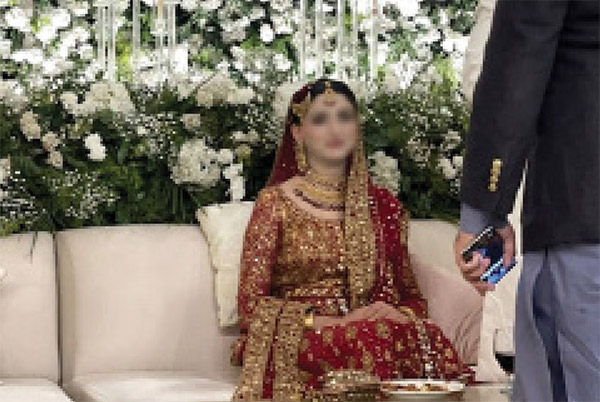
Image 1
The bride sits before an elaborate floral installation, dressed in a Bunto Kazmi ensemble reportedly valued at approximately PKR 3 million, paired with heavy gold jewellery. The image illustrates how bridal aesthetics function as a direct display of class, where designer labels and material value become central to how weddings are staged, captured, and circulated.
Photo credit: Authors’ fieldwork

Image 2
Post-wedding communication reveals the urgency of digital circulation, with requests to upload and tag content immediately after the event. Sharing is not optional but expected, reflecting how social validation is embedded into the wedding’s afterlife.
Photo credit: Authors’ fieldwork
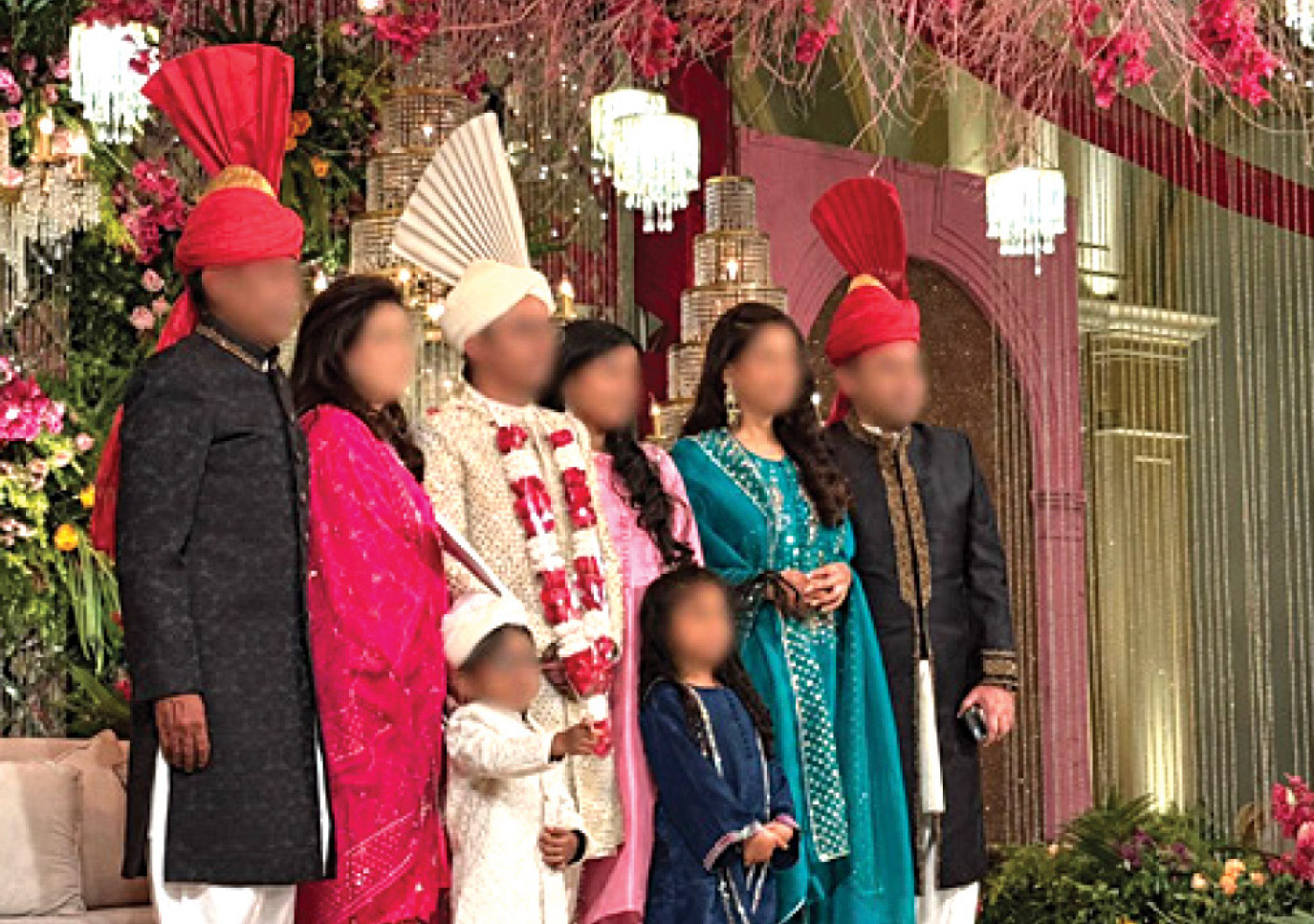
Image 3
Family members gather on a decorated stage, pausing for a formal photograph under carefully curated lighting and décor. Such staged group portraits reflect how weddings are structured around visibility, where moments are organized for documentation rather than spontaneity.
Photo credit: Authors’ fieldwork
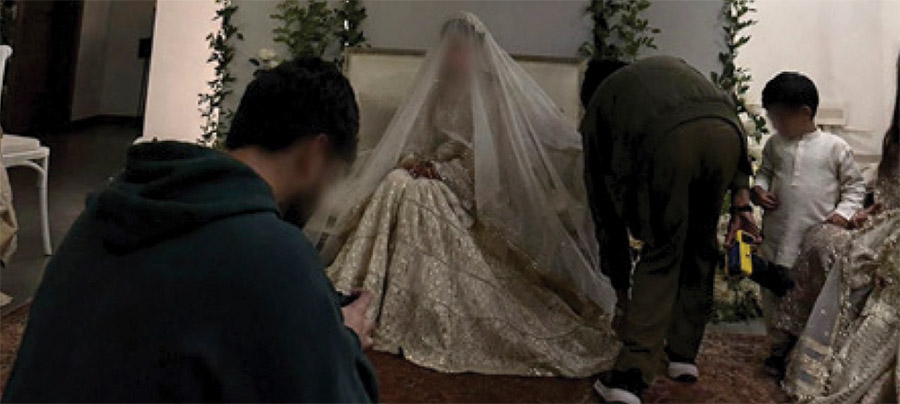
Image 4
In contrast to large-scale venues, a more intimate setting presents a simplified aesthetic, yet the bride remains positioned for photography under controlled lighting. Even smaller weddings reflect the same emphasis on visual composition, showing how digital expectations extend across different scales of celebration.
Photo credit: Authors’ fieldwork
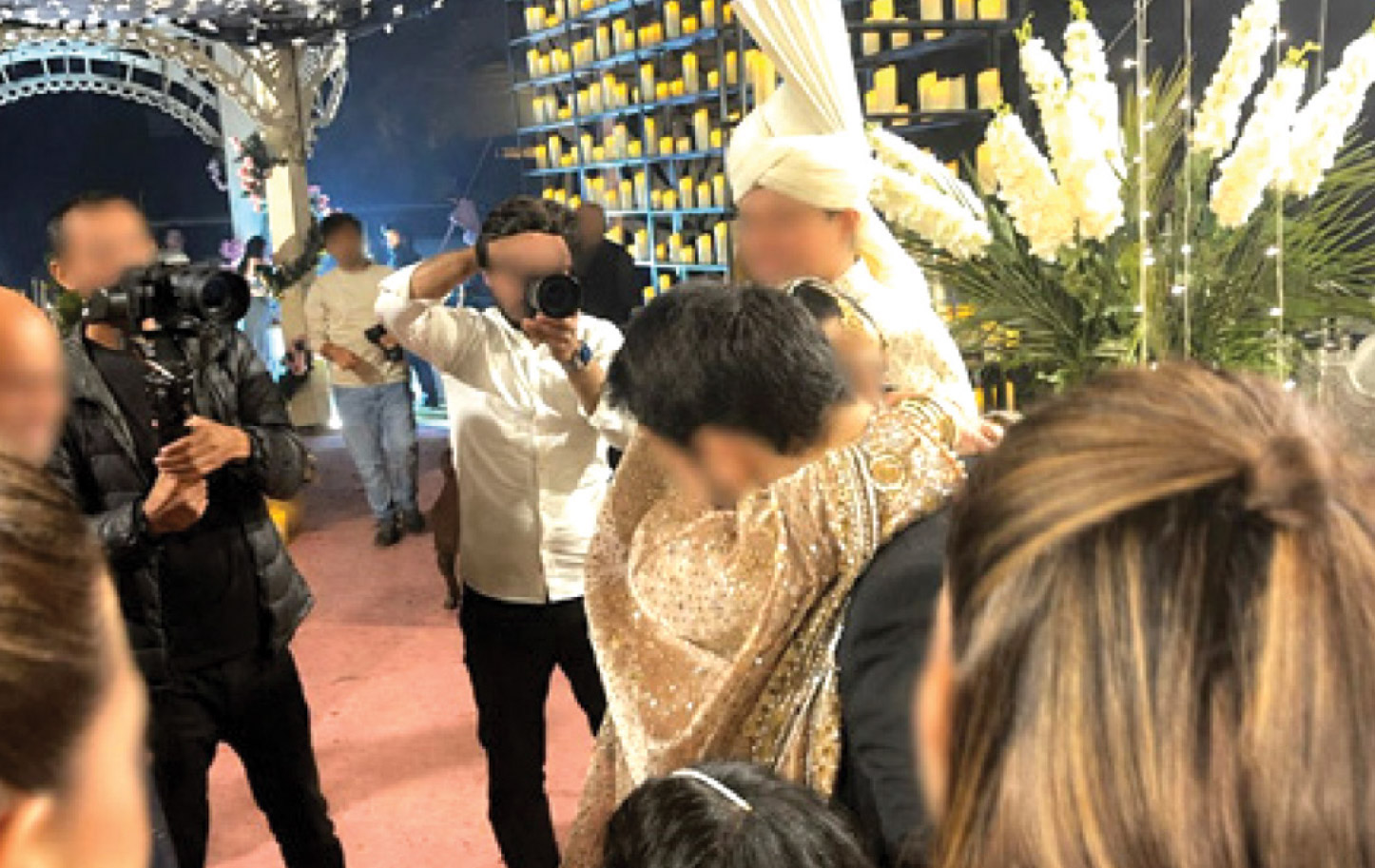
Image 5
An intimate rukshati moment is surrounded and directed by multiple photographers, with cameras framing the interaction from all sides. Emotional expressions are captured through layers of mediation, highlighting how even private moments are produced for future viewing.
Photo credit: Authors’ fieldwork